
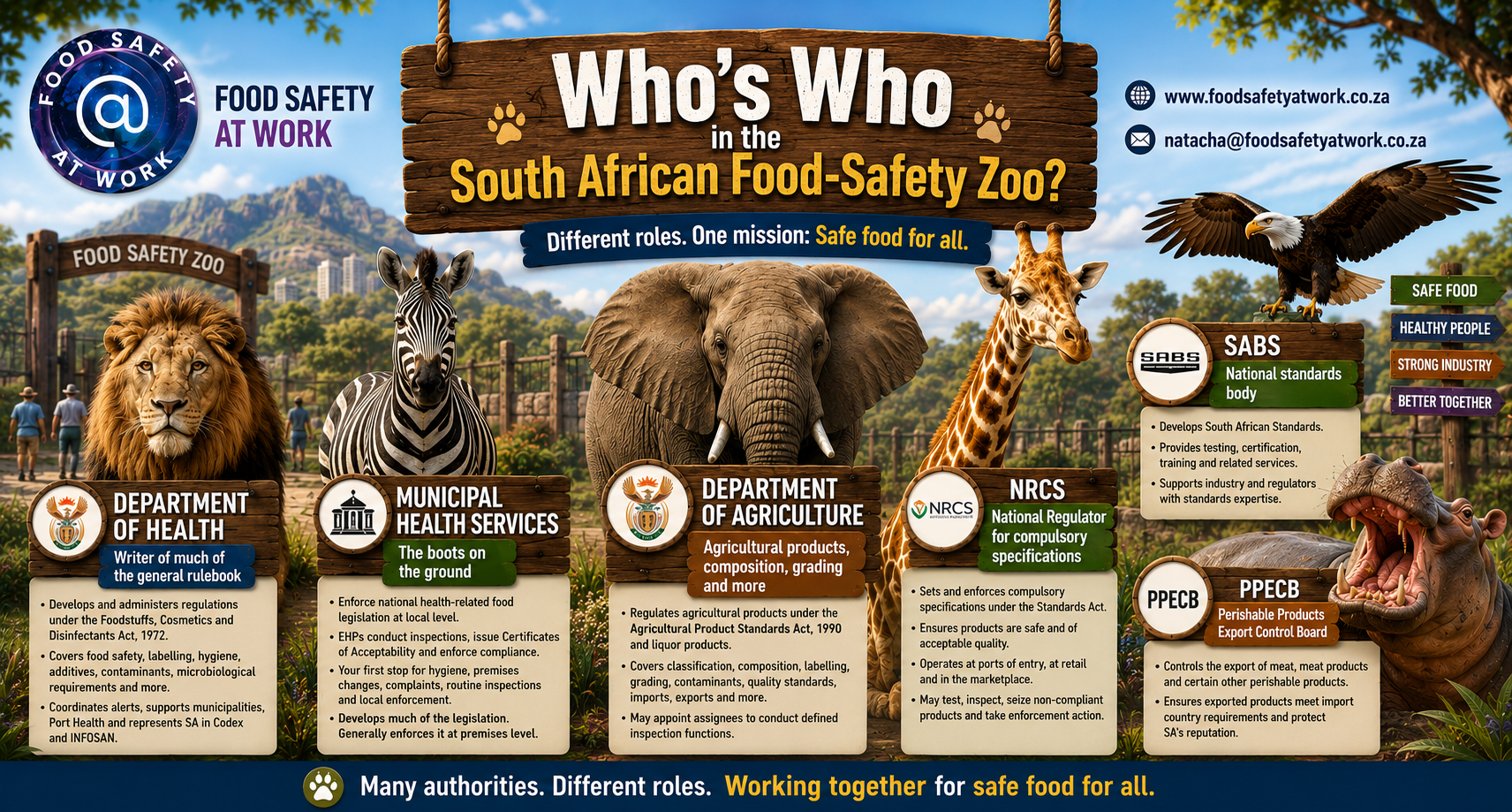
Who writes the rules, who inspects the premises, and who gets the call when something goes wrong?
1. The situation: everyone knows there is a regulator—nobody agrees which one
A customer sends you a question about the wording on a yoghurt label.
Production wants to convert an unused storeroom into a new preparation area.
Purchasing is considering an imported frozen-fish product.
Then the laboratory reports an out-of-specification result and somebody mentions the word “recall”.
Within five minutes, the suggestions begin:
“Call the Department of Health.”
“No, this is an Agriculture matter.”
“Shouldn’t the municipality handle it?”
“What about the NRCS?”
“We had better tell the NCC.”
“Maybe SABS will know?”
Eventually, everyone turns to the food-safety manager and asks:
“So, who is actually our regulator?”
The slightly inconvenient answer is: possibly more than one of them.
South Africa does not have one food-safety authority responsible for every product, premises and stage of the supply chain. Responsibility is divided among national departments, municipalities, provincial authorities, statutory regulators and border authorities.
Which authority becomes involved depends on:
- what the product is;
- what you are doing with it;
- where the activity takes place;
- whether it is locally produced, imported or exported; and
- what has gone wrong.
Welcome to the South African food-safety zoo. Let us meet the main inhabitants.

2. The difficult bit: who does what?
The National Department of Health: writer of much of the general rulebook
The National Department of Health’s Directorate: Food Control develops and administers regulations under the Foodstuffs, Cosmetics and Disinfectants Act, 1972.
These regulations cover areas such as:
- general food safety;
- hygiene requirements;
- food labelling;
- regulatory nutrition;
- additives;
- contaminants;
- microbiological requirements; and
- related food-control matters.
The Directorate also coordinates food-safety alerts, provides technical support to municipalities, supports the Border Management Authority’s Port Health function and represents South Africa in bodies such as Codex Alimentarius and INFOSAN.
However, the National Department of Health is not necessarily the authority that will arrive at your restaurant, warehouse or factory to conduct a routine premises inspection.
That job usually belongs to someone closer to home.

Municipal Health Services: the boots on the ground
The enforcement of national health-related food legislation is delegated to Municipal Health Services in district and metropolitan municipalities. Environmental Health Practitioners, commonly called EHPs, perform many of the practical inspection and enforcement functions at local level.
Under R638, the relevant local authority receives applications for Certificates of Acceptability and refers them to an inspector. The inspector evaluates the premises before recommending whether the certificate should be issued.
Your Municipal Health Services or EHP will therefore usually be the first door to knock on for matters involving:
- a Certificate of Acceptability;
- hygiene conditions at food premises;
- changes to premises or food-handling activities;
- food-handler hygiene;
- local complaints about food premises;
- routine inspections; and
- local enforcement of Department of Health food regulations.
A useful distinction is:
The National Department of Health develops much of the legislation. Municipal Health Services generally enforce it at premises level.
This is why sending a Certificate of Acceptability application to the national department is unlikely to get you very far. The application belongs with the local authority responsible for the area in which the premises are situated.

The Department of Agriculture: agricultural products, composition, grading and more
The Department of Agriculture regulates the quality and food safety of certain agricultural products under the Agricultural Product Standards Act, 1990. It also administers requirements relating to liquor products under separate legislation.
Depending on the product, agricultural-product requirements may address:
- classification and grading;
- composition;
- product names;
- packaging;
- marking and labelling;
- microbiological contaminants;
- quality standards;
- local sales;
- imports; and
- exports.
This is where requirements such as the difference between full-fat and low-fat yoghurt, the composition of fruit juice, the classification of meat and the correct description of certain agricultural products may enter the picture.
The Department can also appoint assignees to conduct defined inspection functions at points such as manufacture, packing, sale and export.
An assignee should not be confused with your certification body. An assignee performs a defined regulatory inspection function on behalf of the Department for particular products. Your ISO 22000, FSSC 22000 or BRCGS auditor performs a private certification audit.
The same person may inspect your site with a clipboard, but the legal authority behind that clipboard is very different.

Veterinary Public Health: the abattoir and meat-safety specialists
Where slaughtering and abattoirs are concerned, the Meat Safety Act, 2000 becomes particularly important.
The Act provides for meat-safety measures, national standards for abattoirs, meat inspection and the regulation of meat imports and exports. It requires animals and carcasses to be examined and meat to be handled, inspected, marked and released according to prescribed requirements.
At provincial level, Veterinary Public Health authorities may be involved in:
- registering and grading abattoirs;
- inspecting abattoir facilities;
- auditing hygiene systems;
- overseeing meat-inspection services;
- monitoring residues and microbiological risks;
- investigating illegal slaughtering; and
- verifying certain meat and animal-product exports.
A retail butchery may therefore interact with its municipal EHP regarding the hygiene of the shop, while the abattoir supplying the meat falls under veterinary and meat-safety controls.
Same meat. Different part of the supply chain. Different authority.

The NRCS: the compulsory-specification specialist
The National Regulator for Compulsory Specifications, or NRCS, falls under the Department of Trade, Industry and Competition.
The NRCS develops and administers compulsory specifications and conducts market surveillance to ensure that regulated products comply with those specifications.
Within the food sector, compulsory specifications apply to specific product categories rather than every food product. Examples include certain frozen fish and marine products and canned meat products. These specifications can include requirements for factory approval, product approval, food-safety systems, testing, handling, storage and continuing conformity.
The important question is therefore not:
“Does the NRCS regulate food?”
It does.
The better question is:
“Does an NRCS compulsory specification apply to our particular product and activity?”
A factory can comply with R638 and hold a valid Certificate of Acceptability but still fail to obtain an approval required by an applicable compulsory specification.
One approval does not automatically replace another.

The National Consumer Commission: consumer protection and recalls
The National Consumer Commission, or NCC, administers and enforces the Consumer Protection Act.
Its responsibilities include investigating alleged prohibited conduct, supporting consumer redress and protecting consumers from unsafe goods. The NCC also plays a central role in consumer-product recalls, including food recalls.
Suppliers are expected to have systems that enable unsafe products to be identified and recalled effectively. Suppliers conducting a recall must notify the NCC, and the Commission may order a mandatory recall when necessary to protect the public.
A food recall may therefore involve several authorities.
For example:
- the NCC may oversee the consumer-product recall;
- the municipality or Department of Health may be involved in a hygiene, labelling or contaminant matter;
- Agriculture may become involved if an agricultural-product standard has been breached; and
- the NRCS may become involved if the product is covered by a compulsory specification.
Telling one authority does not necessarily mean that every other relevant authority has automatically been informed.
Your recall procedure should identify the regulators applicable to your products before an emergency takes place.

The Border Management Authority: the gatekeeper
Imported food can attract an especially impressive collection of acronyms.
The Border Management Authority, or BMA, performs border law-enforcement functions at South Africa’s ports of entry. Its specialised functions include Port Health and Port Agriculture.
Port Health is described by the BMA as the first line of defence against public-health risks associated with international travel and trade. Port Agriculture deals with agricultural biosecurity matters such as plant and animal products, permits, pests and diseases.
The National Department of Health provides technical support to the BMA’s Port Health service regarding the control of imported foodstuffs under the Foodstuffs, Cosmetics and Disinfectants Act.
Depending on the product, an importer may also need to deal with:
- the Department of Agriculture;
- the NRCS;
- other product-specific authorities;
- SARS Customs; and
- the relevant authority responsible for permits or health certification.
This is why “the supplier said it was fine to import” is not a particularly strong import-control procedure.

SABS and SANAS: important, but not the food police
The South African Bureau of Standards, or SABS, develops and maintains South African National Standards.
Standards are generally designed for voluntary use. However, a law, regulation, compulsory specification or contract may refer to a standard and make compliance with it mandatory in that context.
The South African National Accreditation System, or SANAS, accredits laboratories, inspection bodies, certification bodies and other conformity-assessment organisations. Accreditation provides confidence in the competence of the organisation performing the test, inspection or certification.
A simple way to remember the difference is:
- SABS develops standards.
- SANAS accredits competent conformity-assessment bodies.
- Regulators enforce legislation within their mandates.
- Certification bodies audit against certification standards or schemes.
A SANAS-accredited laboratory result may provide strong evidence, but SANAS does not normally decide whether your product should be recalled.
An FSSC 22000 certificate may give customers confidence in your management system, but it does not replace a Certificate of Acceptability.
A customer audit may contain extremely sensible requirements, but that does not automatically make every customer requirement South African law.

A quick “which door first?” guide
Premises hygiene or a Certificate of Acceptability:
Start with the Municipal Health Services or EHP responsible for your premises.
General food labelling, additives, contaminants or regulatory nutrition:
Consult the applicable Department of Health regulations. Enforcement is generally carried out through Municipal Health Services.
Composition, grading, classification or marking of a regulated agricultural product:
Check the Department of Agriculture’s requirements and whether an appointed assignee is involved.
Slaughtering, abattoir registration or meat inspection:
Contact the applicable Veterinary Public Health authority.
A product covered by a compulsory specification:
Check the NRCS requirements, approvals and conformity procedures.
A consumer-product recall:
Notify the NCC and identify every other technical or local regulator that may also require notification.
An imported food consignment:
Check the BMA requirements at the port, together with the product-specific requirements of Health, Agriculture, the NRCS and any other relevant authority.
A national standard, laboratory or certification question:
Think SABS, SANAS or your certification body—but do not confuse them with the regulator responsible for legal enforcement.

3. Why should we care?
Knowing who regulates what is not simply useful trivia for the food-safety team.
It affects:
- which legislation appears in your legal register;
- which approvals and permits you need;
- who must be consulted before a change is made;
- where applications must be submitted;
- which authority must be notified during an incident;
- whether imported or exported goods can be released;
- how quickly a recall can be activated; and
- whether regulatory correspondence reaches the correct person.
Consider a yoghurt manufacturer.
The business may need to consider:
- Municipal Health Services for its Certificate of Acceptability and premises hygiene;
- Department of Health regulations for general labelling, additives, contaminants and nutrition information;
- Department of Agriculture requirements for product composition, class designation and marking;
- an accredited laboratory for reliable analytical testing;
- the NCC if an unsafe product requires recall; and
- a private certification body if the site is certified against a food-safety scheme.
That is one tub of yoghurt and several different sets of requirements.
A legal register containing one vague line stating “comply with food legislation” will not manage this complexity.
There is also one more important member of the zoo: your own business.
The National Department of Health states that the primary responsibility for food safety and accurate labelling rests with the producer, manufacturer, seller or importer. Regulators set and enforce requirements, but they do not operate your food safety management system for you.

4. What should we do before Monday morning?
Action 1: Build a regulator map—not only a legal register
Select your main products, processes and sites and identify:
- the applicable Act, regulation or compulsory specification;
- the responsible authority;
- any appointed assignee;
- the required certificate, permit, registration or approval;
- the routine contact person or office;
- the emergency or recall contact;
- the person responsible within your organisation; and
- the date on which the information was last verified.
Do not create one generic entry for the entire company if different sites, products or activities fall under different requirements.
A useful heading for the document is:
Who regulates what, where and why?
That is much easier to use during an emergency than a folder containing 300 unsorted PDFs.

Action 2: Separate law from standards, schemes and customer requirements
Divide your external requirements into four clear groups:
- Acts and regulations
These are legal requirements.
- Compulsory specifications, permits and regulatory approvals
These are mandatory where their scope applies.
- Standards and certification-scheme requirements
These may be voluntary, contractual or required by a customer. Some standards become mandatory when incorporated into legislation or a compulsory specification.
- Customer and internal requirements
These can be stricter than legislation but should not automatically be described as “the law”.
This prevents two common problems:
- treating an auditor’s preference as legislation; and
- assuming that certification against a private standard proves full legal compliance.

Action 3: Run a 15-minute regulator drill
Give the food-safety team one of these scenarios:
- A pathogen is detected in released product.
- An undeclared allergen is discovered on a label.
- A major production-room extension is planned.
- An imported consignment is detained at the port.
- A customer reports that packaging is swelling.
- A supplier announces a raw-material recall.
The team must answer:
- Which authorities could become involved?
- Who makes the first contact?
- What information will the authority require?
- Who is authorised to speak for the business?
- Where are the current contact details kept?
- Which other customers, certification bodies or insurers must be notified?
- Who records the decisions and communications?
Do not wait for a real recall to discover that the emergency contact number belongs to someone who left the organisation three years ago.

5. Let’s talk
Choose your highest-risk product.
From raw-material approval to manufacture, sale and possible recall, how many different South African authorities could become involved—and can your team explain the role of each one?
That is an excellent discussion for your next food-safety team meeting.